How do you inject testosterone at home?
Learning to give yourself a testosterone injection at home can feel intimidating at first, but for most people, it becomes a quick, manageable routine within just a few sessions. This guide walks through everything someone starting testosterone replacement therapy (TRT) needs to know, from gathering supplies to disposing of needles safely.
Key takeaways · Updated October 26, 2026
- TRT injections treat diagnosed low testosterone with cypionate or enanthate.
- Injections can be intramuscular or subcutaneous; your provider chooses the route.
- Use the right supplies, a clean technique and rotate injection sites such as the thigh.
- Store vials at room temperature and dispose of needles in an FDA-cleared sharps container.
What is testosterone injection therapy?
TRT is a treatment for diagnosed low testosterone (hypogonadism). The most common injectable forms are testosterone cypionate and testosterone enanthate, prescribed at a dose set by your provider.
TRT is a medical treatment used when the body does not produce enough testosterone on its own, a condition known as hypogonadism (low testosterone). A healthcare provider diagnoses this condition and prescribes the appropriate form and dose. The most commonly prescribed injectable forms are testosterone cypionate and testosterone enanthate, both of which are oil-based solutions delivered into muscle tissue or just beneath the skin.
Self-injection at home, when prescribed and supervised by a doctor, is completely safe and widely practiced. The goal of this guide is to help patients feel confident, informed, and comfortable with the process.
Should testosterone be injected into muscle or under the skin?
Both work. Intramuscular injections go deep into muscle and have been standard for decades, while subcutaneous injections go into the fat layer under the skin and many people find them easier; your provider decides.
There are two main routes for testosterone injections:
- Intramuscular (IM) injection: Delivers the medication deep into muscle tissue. This has been the standard method for nearly 80 years and produces predictable hormone levels.
- Subcutaneous (SC) injection: Delivers the medication into the fatty layer just beneath the skin. Research shows that SC injections produce comparable testosterone levels to IM injections and may be easier to self-administer with less discomfort.
Both methods are safe and effective. A doctor will recommend the right one based on individual needs, body composition, and the specific testosterone formulation prescribed.
What supplies do you need to inject testosterone?
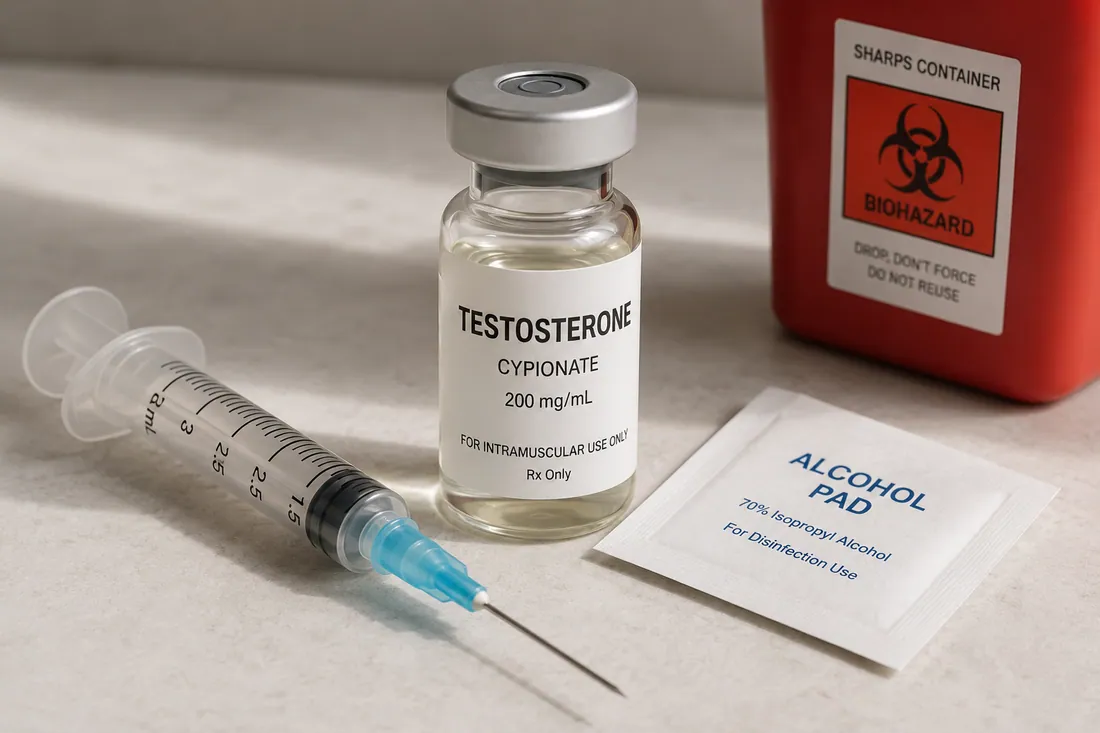
You need your prescribed vial, a 3 mL syringe, a larger 18-gauge needle to draw the medication, a smaller injection needle, alcohol swabs, gauze and a sharps container.
Having everything ready before beginning makes the process smoother and reduces the risk of contamination. Here is what to gather:
- The prescribed testosterone vial
- A 3 mL syringe
- A larger 18-gauge (18G) drawing needle, used to draw the medication into the syringe (testosterone is thick and needs a wider needle for this step)
- A smaller injection needle, typically 22–25 gauge, 1–1.5 inches for intramuscular injections; or a 25–27 gauge, ½–⅝ inch needle for subcutaneous injections
- Alcohol swabs
- Adhesive bandage (plaster)
- A sharps disposal container (a yellow sharps bin or a sturdy, puncture-resistant household container)
Tip: Needle length may need to be adjusted based on body composition. Individuals with higher body weight may need a longer needle (1.5 inches) to ensure the medication reaches the muscle.
Where is the best place to inject testosterone?
The outer middle third of the thigh (vastus lateralis) is the most recommended site for self-injection because it is easy to see and reach. Rotate sites to prevent scar tissue.
Injection site selection affects both comfort and how well the medication absorbs. There are several options, and rotating between them helps prevent scar tissue buildup over time.
The thigh (vastus lateralis)
The outer middle third of the thigh is the most recommended site for self-injection because it is easy to see and reach without help. Divide the thigh visually into three equal sections and inject into the middle section along the outer edge, never on the inner thigh, where there are important blood vessels and nerves.
The ventrogluteal site (hip area)
The ventrogluteal area, located at the side of the hip between the hip bone and the thigh, is considered one of the safest IM injection sites because it has fewer major nerves and blood vessels nearby. It requires a little practice to locate but is well-tolerated by most people.
The buttock (gluteus maximus)
The gluteal muscle is the FDA-approved primary site for testosterone cypionate and enanthate injections. For self-injection, targeting the upper outer quadrant of the buttock reduces the risk of hitting the sciatic nerve. This site is often easier when another person assists.
The deltoid (upper arm)
The upper arm can be used for smaller volumes (up to 1–2 mL), approximately 2.5–5 cm below the shoulder tip. It is a practical site for many people doing subcutaneous injections.
Site rotation
Repeatedly injecting in the same spot can lead to tissue damage and scarring, which affects how the medication absorbs. Rotating across at least 4–6 different sites is strongly recommended.
How do you give yourself a testosterone injection?
Wash your hands, check the vial, clean the stopper, draw the dose with the larger needle, switch to the injection needle, clean the site, inject slowly as instructed and dispose of the needle safely.
Step 1 — prepare the space
Find a well-lit, clean surface to work on. Wash hands thoroughly with soap and water. Lay out all supplies before starting.
Step 2 — check the medication
Remove the testosterone vial from storage and check:
- The label to confirm it is the correct medication
- The expiry date
- The liquid should be clear and free of particles or discoloration. Do not use it if it looks cloudy or has visible bits.
Step 3 — draw up the medication
- Wipe the rubber top of the vial with an alcohol swab and allow it to dry.
- Attach the drawing needle (18G) to the syringe.
- Pull back the plunger to draw in a small amount of air equal to the prescribed dose.
- Insert the needle through the rubber stopper, invert the vial, and inject the air in, this creates pressure that makes it easier to draw out the liquid.
- Slowly pull back the plunger to withdraw the correct dose.
- Remove the needle from the vial, then carefully swap the drawing needle for the injection needle (22–25G for IM; 25–27G for SC).
- Hold the syringe upright, tap it gently to bring any air bubbles to the top, then slowly push the plunger slightly to expel the air bubbles.
Step 4 — prepare the injection site
Clean the chosen site with an alcohol swab and allow it to air dry completely before injecting, injecting through wet skin can introduce bacteria into the muscle.
Step 5 — give the injection
For intramuscular injection:
- With the non-dominant hand, spread or slightly tighten the skin at the injection site.
- Insert the needle at a 90-degree angle with a quick, firm motion, hesitating makes it more uncomfortable.
- Once the needle is fully inserted, release the skin and gently pull back the plunger. If blood appears in the syringe, the needle has entered a blood vessel, remove the needle immediately, discard it, and start again with a new syringe.
- If there is no blood, slowly push the plunger all the way down to inject the medication. Testosterone is thick, so this may take a few seconds.
For subcutaneous injection:
- Gently pinch a fold of skin and fatty tissue at the chosen site.
- Insert the needle at a 45-degree angle into the pinched skin.
- Release the pinch and slowly push the plunger down.
Step 6 — after the injection
- Remove the needle smoothly and apply gentle pressure with a clean swab or cotton ball.
- Apply a bandage if there is any light bleeding.
- Gently massage the area to help distribute the medication and ease any discomfort.
How often do you inject testosterone?
Cypionate and enanthate are typically injected every 2 to 4 weeks, with some patients dosing weekly for steadier levels; your provider sets the schedule.
Injection frequency depends on the type of testosterone prescribed and how the body responds to treatment. Common schedules include:
- Testosterone cypionate: typically every 2–4 weeks (some patients do weekly for more stable levels)
- Testosterone enanthate: typically every 2–4 weeks
- Testosterone propionate: every 2–3 days (less common due to frequent dosing)
Splitting a weekly dose into two smaller injections twice per week can help maintain more stable hormone levels and reduce side effects like mood swings, fatigue, and water retention. Always follow the dosing schedule set by a healthcare provider, never adjust doses independently.
How can you make testosterone injections hurt less?
Let the vial reach room temperature, wait for the alcohol to dry, use a fresh needle for injecting, relax the muscle and inject slowly.
Many people are surprised by how manageable the process becomes once they get started. A few practical tips help make it more comfortable:
- Allow the testosterone vial to reach room temperature before injecting, cold oil is harder to push through the needle and more uncomfortable
- Let the skin dry fully after cleaning with an alcohol swab before inserting the needle
- Keep the muscles at the injection site as relaxed as possible, tensing makes it hurt more
- Break through the skin with a quick, confident motion rather than a slow push
- Avoid changing the needle's direction while it is inside the body
- Rotate injection sites consistently to prevent soreness and scar tissue buildup
What are the side effects of testosterone injections?
Common mild effects include soreness or bruising, acne or oily skin, mild mood changes and fluid retention. Persistent or severe symptoms need a doctor’s review.
Like any medication, testosterone injections can have side effects. Most are manageable, but some require medical attention.
Common, mild side effects may include:
- Soreness or bruising at the injection site
- Mild mood changes shortly after injection
- Acne or oily skin
- Fluid retention (mild swelling)
Side effects requiring a doctor's review include:
- Persistent redness, warmth, or swelling at the injection site, which may signal infection
- Significant mood changes
- Polycythemia (an increase in red blood cell count), this is why regular blood monitoring is essential during TRT
Seek emergency care immediately if any of the following occur after injection:
- Chest pain or shortness of breath
- Sudden severe headache or vision changes
- Difficulty swallowing or throat tightness (rare but serious, particularly with testosterone undecanoate)
- Ankle swelling or signs of a blood clot
How should you store testosterone and dispose of needles?
Store vials at room temperature (60–80°F / 15–27°C), away from light, heat and moisture, and place used needles immediately in an FDA-cleared sharps container.
Medication storage matters for both safety and effectiveness. Testosterone vials should be stored at room temperature (60–80°F / 15–27°C), away from direct sunlight, heat, and moisture, and well out of reach of children and pets.
For needle disposal, the FDA recommends placing used needles immediately into an FDA-cleared sharps container, a rigid, puncture-resistant container with a secure lid. If an official sharps container is unavailable, a heavy-duty plastic container such as a laundry detergent bottle with a screw-on lid is an acceptable alternative.
Key rules for sharps disposal:
- Never throw loose needles into household trash or flush them down the toilet
- Never recap, bend, or break used needles, this increases the risk of accidental needlestick injury
- Never overfill a sharps container, dispose of it when it is three-quarters full
- Check local guidelines for how to drop off or mail in filled sharps containers, as rules vary by location
Managing your testosterone therapy just got easier with Doctor Adam, a trusted online men's health platform that connects patients with licensed medical providers who specialize in testosterone replacement therapy (TRT) and hormone optimization. Whether someone is just beginning to explore treatment or looking to fine-tune an existing regimen, Doctor Adam offers personalized care, prescription management, and expert guidance, all from the comfort of home. No long waits, no confusing medical jargon, just straightforward, doctor-led support designed to help men feel their best.
Frequently asked questions
What happens if testosterone is injected in the wrong spot?
Injecting into the wrong area, such as accidentally hitting fatty tissue instead of muscle — means the medication may absorb more slowly or unevenly, potentially affecting how well symptoms are controlled. In rare cases, injecting too close to a nerve can cause temporary pain or tingling; if this happens, the needle should be withdrawn immediately and a different site used.
Is subcutaneous testosterone injection as effective as intramuscular?
Yes, research confirms that subcutaneous testosterone produces comparable hormone levels to intramuscular injections. Many patients actually prefer the subcutaneous route because it uses a shorter, thinner needle and causes less discomfort, making it easier to self-administer and more likely to support long-term treatment adherence.
How long does it take for testosterone injections to work?
Most people begin noticing improvements in energy, mood, and libido within 3–6 weeks of starting treatment, though full benefits, including changes in muscle mass, bone density, and sexual function, typically develop over several months. Blood levels are monitored regularly to ensure the dose is appropriate and that no complications are developing.

Medically reviewed by Jaclyn P. Leyson-Azuela, RMT, MD, MPH
Jaclyn P. Leyson-Azuela, RMT, MD, MPH, is a physician, medical writer, and researcher with a strong background in public health, clinical medicine, and academic instruction. She has served as an Assistant Professor teaching core medical sciences, a Doctor-to-the-Barrio delivering frontline care in underserved communities, and a COVID-19 facility manager during the pandemic.